Your Cart is Empty


For a lot of people just starting out, the best synthesizers are the ones that feel intuitive and hands-on. Think of instruments like the Korg Minilogue XD or the Arturia MicroFreak. These models nail the balance between powerful sound design features and a layout that just makes sense, letting you learn the fundamentals without getting bogged down.
The key is finding a synth that makes you want to experiment right out of the box.
Diving into the world of synthesizers is a massive creative buzz, and honestly, there's never been a better time to start. Forget those intimidating images of studio walls covered in tangled cables and complex modules. Today's beginner synths are all about being immediate, fun, and incredibly rewarding.
They offer a direct path to crafting completely unique sounds from scratch. The focus has shifted away from endless menu-diving and toward the simple, tactile joy of twisting a knob and hearing an instant, satisfying change.
This welcoming vibe for newcomers is being fuelled by a seriously growing music scene right here in Australia. As more people discover electronic genres on streaming platforms, the hunger for accessible music creation tools has absolutely skyrocketed.
In fact, Australia’s music market was valued at around USD 245.5 million in 2024 and is tipped to more than double by 2033. It’s a clear sign of a nationwide passion for new sounds. If you're interested, you can explore more data on this music market growth and what's driving it.
This boom means manufacturers are putting out some of the best synths for beginners we’ve ever seen, packing professional-grade sound into packages that are both user-friendly and affordable.
To cut through the noise, here's a quick rundown of what really matters when you're picking out your first synth. Think of this as your starting checklist.
| Consideration | Why It Matters for a Beginner | What to Look For |
|---|---|---|
| Knob-per-Function Layout | This means less menu diving and more hands-on, intuitive learning. You can see and feel every change you make. | A synth with dedicated knobs and sliders for major parameters like filter cutoff, resonance, and envelope stages. |
| Sound Engine (Analog vs. Digital) | Analog synths often have a warmer, classic sound, while digital synths offer more versatility and sometimes weirder sounds. | Listen to demos! Do you prefer the rich tones of an analog like the Minilogue or the experimental edge of a digital like the MicroFreak? |
| Polyphony | This is how many notes you can play at once. Monophonic (one note) is great for basslines, while polyphonic (multiple notes) is essential for chords. | For playing pads and chords, look for at least 4 voices of polyphony. Monosynths are fine for leads and bass. |
| Built-in Sequencer/Arpeggiator | These tools are fantastic for generating ideas and creating music without needing to be a piano virtuoso from day one. | A simple step sequencer or an arpeggiator with a few different patterns can be incredibly inspiring. |
| Presets | Having a good library of presets gives you a starting point to explore different sounds and learn how they're made. | Look for a synth with at least 100 presets, with some user slots to save your own creations. |
This table should help frame your thinking, but don't forget the most important factor: does it make you excited to create?
At the end of the day, the 'best' synthesizer isn't the one with the most features or the biggest price tag. It's the one that makes you want to sit down and make music.
Your perfect first synth should have a workflow that feels natural to you, encouraging you to mess around and experiment every single day.
The most important thing is to pick a synth that inspires you to sit down and create. All of these keyboards are beginner-friendly, but they also leave room to grow.
Whether you're drawn to the warm, classic tones of an analog synth or the wild, endless possibilities of a digital one, the goal is the same. Find an instrument that feels like a creative partner on your sonic adventures, not a puzzle you have to solve. This guide is here to be your practical starting point for finding that perfect match.
Before diving into models and features, let's pull back the curtain on how synthesizers work. You don't need a degree in audio engineering, but a quick rundown of the basics will make a world of difference when you're staring at a panel of knobs and sliders. Think of it like knowing what flour, yeast, and water do before you try to bake a loaf of bread.
At the very start of any sound is the oscillator (VCO). This is the raw sound source, the synth's vocal cords. It generates a basic, continuous tone. This initial tone isn't very exciting on its own; it's just a simple electronic vibration, often in a shape like a buzzy sawtooth wave or a hollow square wave. Everything that happens next is about taking that raw sound and shaping it into something musical.
Once the oscillator creates a sound, the filter (VCF) is where the real magic begins. A filter carves away parts of the sound, much like a sculptor chisels a block of stone. It removes or boosts certain frequencies to completely change the sound's character. The most common kind you'll encounter is a low-pass filter, which strips out the high frequencies, making a sound feel warmer, darker, or more distant.
A perfect real-world example is the tone knob on an electric guitar. Roll it back, and the bright, sharp edges disappear, leaving you with a muffled, bass-heavy tone. That's a low-pass filter in action. This single control is arguably the most expressive part of any synth, responsible for everything from thumping bass lines to cinematic, sweeping pads.
Okay, we have a tone, and we've shaped its texture. But what happens when you press a key? Does the sound appear instantly like a drum hit, or does it fade in gently like an orchestra's string section? That's the job of the envelope generator, most commonly known as the ADSR.
The envelope dictates the volume of a sound over time, from the moment you press a key to long after you've let it go. It's broken into four distinct stages:
Getting comfortable with the ADSR is your ticket to creative sound design. Just by tweaking these four simple stages, you can transform a basic oscillator sound into a tight bass pluck, a dreamy atmospheric pad, or a sharp keyboard stab.
Finally, to stop your sounds from feeling flat and static, we use a Low-Frequency Oscillator (LFO). An LFO is essentially another oscillator, but its speed is so slow that you don't hear it as a musical note. Instead, we use its repeating wave shape to automatically wiggle, wobble, or modulate other parts of the synth.
You could, for example, assign an LFO to the filter to create that classic "wah-wah" effect you hear in funk music. Or you could apply it to the oscillator's pitch to get a nice, subtle vibrato. It's this constant, cyclical movement that gives your sounds character, dimension, and that professional polish.
One of the first big forks in the road you'll hit when buying a synth is deciding between analog and digital. This isn't just a tech-spec detail; it completely shapes the sound, the feel, and how you'll interact with your instrument.
Think of it like choosing between a vintage film camera and a modern digital one. Both capture incredible images, but the process and the final result have a fundamentally different character.
Analog synths are legendary for their rich, warm, and sometimes wonderfully unpredictable sound. Their tones are generated by actual electronic circuits, which gives them this organic, living quality that so many musicians find addictive. It's why they are often the first choice for creating those huge, room-shaking basslines or soaring, expressive lead melodies.
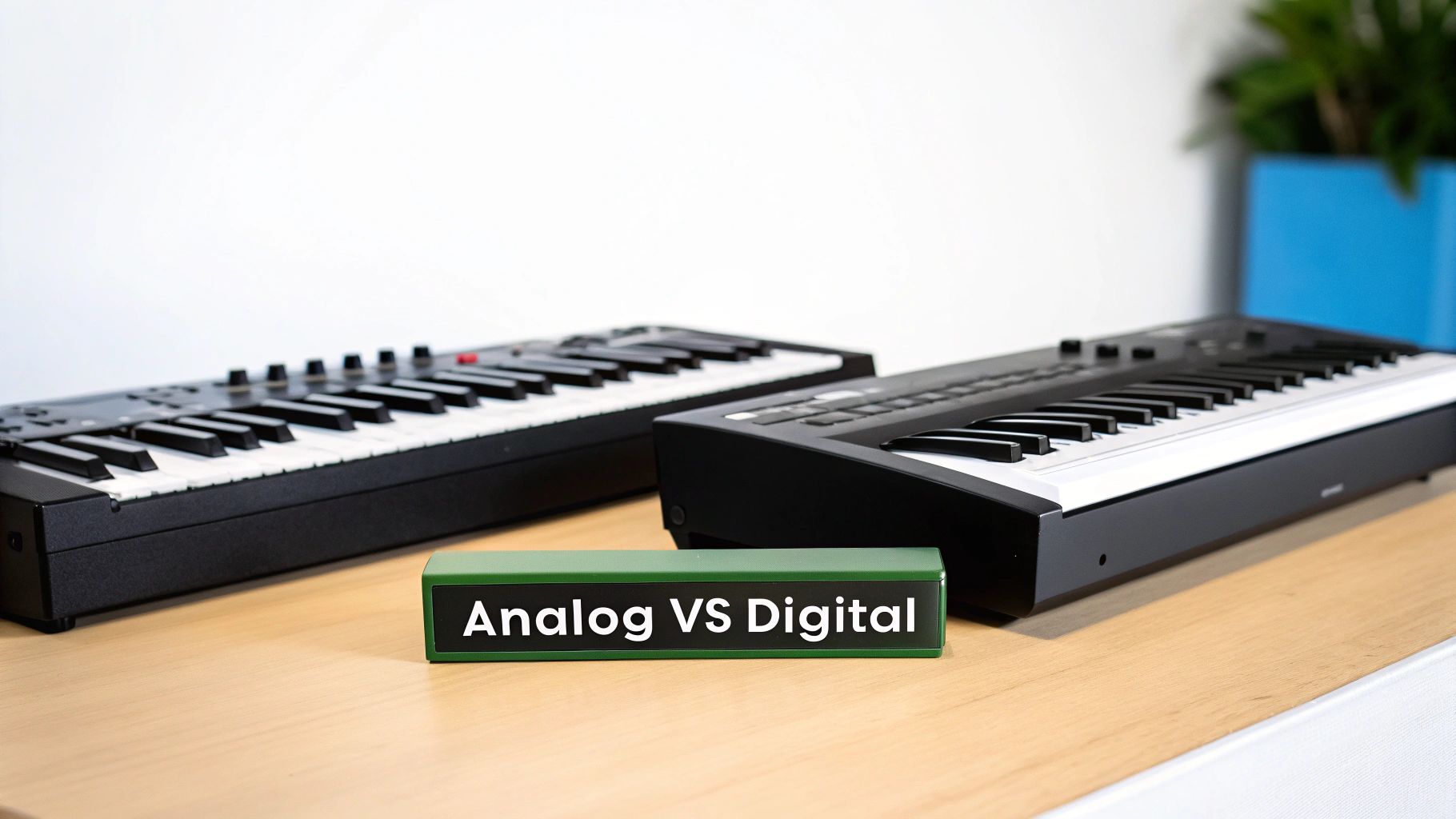
Those tiny imperfections in the analog circuitry mean no two notes are ever exactly the same, adding a subtle life and movement to the sound. For many producers, this warmth is the secret ingredient that makes a track feel authentic. If this hands-on, classic vibe sounds like your thing, our guide on the top five analog synths is a great place to start exploring.
On the other side, you've got digital synthesisers. Instead of physical circuits, these instruments use powerful computer processors to generate and shape sound. This unlocks a universe of sonic possibilities, many of which are difficult or flat-out impossible to get from purely analog gear.
Digital synths are the chameleons of the music world. They can pull off convincing classic analog sounds, sure, but they can also create glassy modern textures, complex evolving pads, and aggressive, futuristic tones with ease.
Here’s why they are so often considered the best synthesisers for beginners:
It's no wonder that digital models are often the go-to for newcomers. The global music synthesiser market was valued at about USD 1.2 billion in 2023, with digital synths leading the charge thanks to their friendly design and massive versatility.
The big question: how do you choose? Honestly, it all comes down to your musical goals and what kind of workflow gets you excited to create.
An analog synth is like working with clay—it’s tactile, immediate, and has a raw, organic character. A digital synth is more like a 3D printer—it offers incredible precision, endless possibilities, and the ability to save and recall your creations perfectly every time.
If you’re drawn to the classic sounds of funk, techno, or vintage pop and you love the idea of a direct, hands-on connection to your sound, an analog synth could be your perfect match.
On the other hand, if you want a versatile workhorse that can cover a huge range of sounds, offers the convenience of presets, and slots easily into a modern computer-based studio, a digital synth is probably the smarter choice. Neither is "better"—they're just different tools for different creative journeys.
Let's get practical. It's easy to dream about a wall of blinking lights, but your first synth needs to fit two real-world constraints: your budget and your room. Finding the best synthesizer for beginners is all about hitting that sweet spot where the price, features, and physical footprint all make sense for you.
To help you out, we’ll break down what you can realistically expect at different price points here in Australia. This should help you narrow down the options and make sure you get the most synth for your money, whether you’ve got a corner of a desk or an entire studio space to play with.
Trying to figure out what your money can actually get you can feel a bit overwhelming. Is a cheaper synth just a toy? Do you really need to spend over a grand? This table breaks it down, giving you a clear picture of the features and possibilities that open up as you move through different budget tiers.
| Budget Tier (AUD) | What to Expect | Best For... | Example Models |
|---|---|---|---|
| Under $500 | Compact desktop modules or mini-key synths. Often monophonic or paraphonic. Mostly digital or hybrid sound engines with fun, built-in sequencers. Plastic but solid builds. | The sonic explorer on a budget, bedroom producers with limited space, or anyone wanting a unique sound source to add to their setup. | Arturia MicroFreak, Korg Volca Series |
| $500 - $1,000 | A significant step up. Often introduces true analog circuits and polyphony (4+ voices). Better build quality and more hands-on controls. Slim or full-sized keys (usually 37) are common. | Someone serious about learning synthesis who wants a primary instrument that won't feel limiting too quickly. The true beginner "sweet spot." | Korg Minilogue XD, Arturia Minibrute 2 |
| $1,000 - $1,500 | Premium build quality (metal chassis, quality keybeds). Expanded polyphony (8+ voices), deeper modulation options, and a more professional sound right out of the box. | The aspiring professional or dedicated hobbyist who wants an instrument that can be the long-term centrepiece of their studio. | Sequential Take 5, Novation Summit |
As you can see, you don't need a massive budget to get started with a powerful and inspiring instrument. It's more about aligning what you spend with your immediate goals and creative workflow.
This price bracket is genuinely exciting right now. Forget thinking of these as "toys"—they're packed with innovative, powerful sound engines perfect for modern music. You’ll mostly find compact desktop modules and mini-keyboard synths that are brilliant for smaller setups.
Sure, there are trade-offs. You might get a monophonic synth (one note at a time) or a paraphonic one (multiple oscillators sharing one filter/amp path). The build will likely be more plastic than metal, but brands like Arturia and Korg are absolute masters at making affordable gear feel solid and ready for action.
This mid-range tier is the sweet spot for a huge number of newcomers, and for good reason. In this zone, you start seeing more robust features, a noticeable jump in build quality, and a more direct, hands-on playing experience that can seriously speed up your learning curve.
Synths in this range, like the celebrated Korg Minilogue XD, often bring true analog warmth and at least four voices of polyphony to the table. Suddenly, you can play proper chords and lush, evolving pads. Keyboards become more common, usually with 37 slim or full-sized keys, giving you a more traditional playing feel.
This is the price range where you stop making major compromises. You can find an instrument that sounds professional, has an intuitive workflow, and offers enough depth to keep you hooked for years.
Once you cross that $1,000 mark, you're looking at premium-grade beginner and intermediate synths. These are instruments built to last, often featuring rugged metal chassis, high-quality keybeds, and professional components under the hood.
Here, you can expect expanded polyphony—often eight voices or more—along with more advanced modulation options and deeper sound-shaping tools. These synths aren’t just a starting point; they’re designed to be a long-term centrepiece for your home studio, offering a direct path to a professional sound without an impossibly steep learning curve.
The image below gives a great visual comparison of three popular models, showing how features, price, and polyphony stack up.
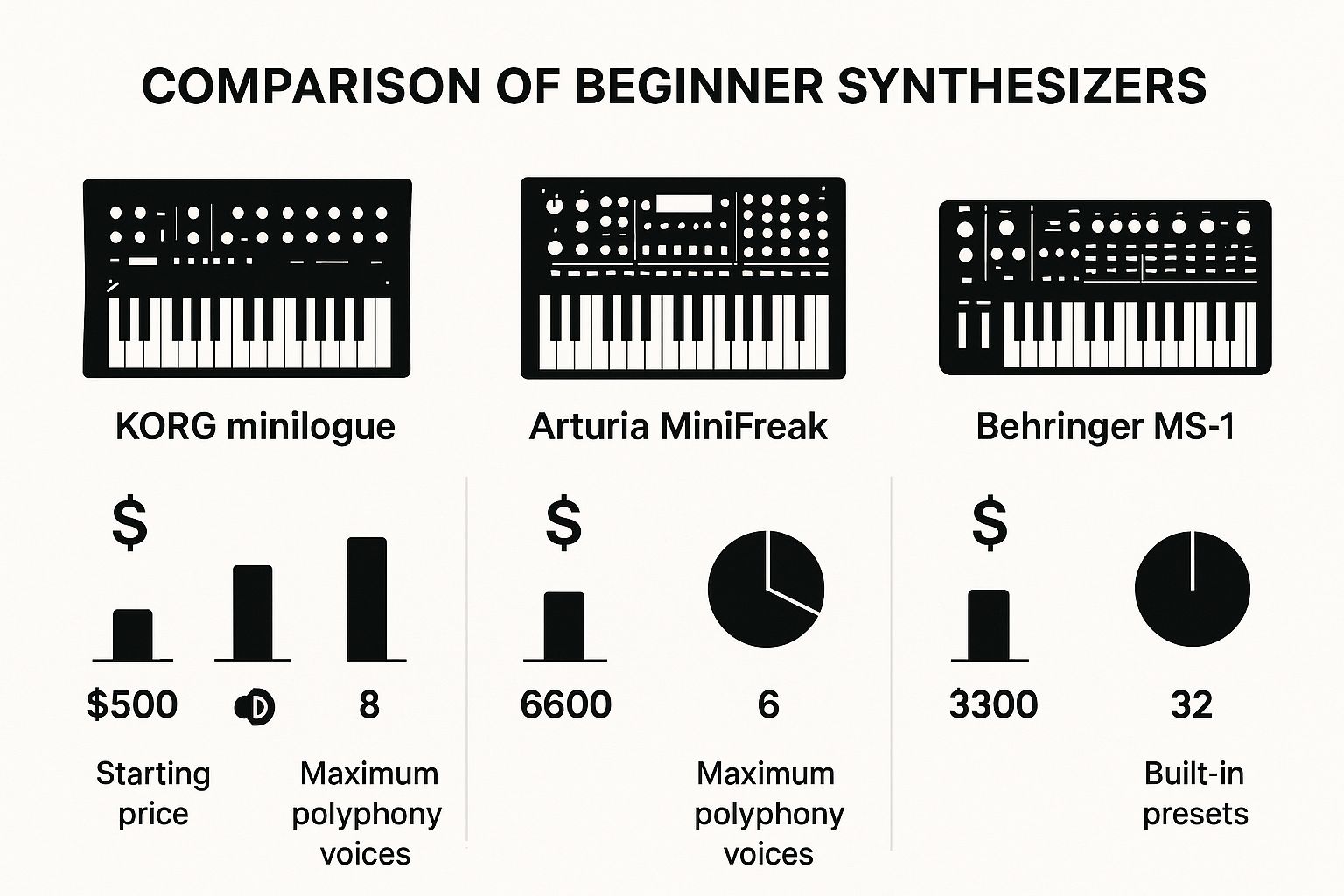
This visual really clarifies the trade-offs. As the price goes up, you generally get more voices and a richer feature set, moving from experimental sound design boxes to more complete and versatile performance instruments.
Alright, let's bring it all together. Now that we've covered the fundamentals, weighed up analog versus digital, and figured out a budget, it’s time for the fun part: looking at some standout models that are perfect for beginners here in Australia.
These aren't just lists of specs; they're instruments celebrated for their intuitive design, inspiring sound, and gentle learning curve. Think of them as the best starting points for your journey into synthesis.
This list features a mix of options to suit different creative goals. We'll look at why each one shines and what kind of music it naturally leans towards, helping you find that perfect first synth to kickstart your adventures in sound design.
The Korg Minilogue XD is consistently recommended as one of the best synthesizers for beginners, and for very good reason. It’s a true hybrid synth, meaning you get the best of both worlds: warm, rich analog oscillators paired with a versatile digital multi-engine. This digital side can add unique textures, noise, or even user-created sounds.
With four voices of polyphony, you can play chords and lush pads right out of the box. The layout is incredibly logical, with almost every function getting its own dedicated knob or switch. This hands-on approach, combined with a small screen that shows you the sound wave you're crafting, makes learning the fundamentals a genuinely fun process.
If your goal is less about playing traditional keyboard parts and more about crafting truly unique, out-there sounds, then the Arturia MicroFreak is an absolute must-see. This compact synth is a creative playground, mixing digital oscillator types with a rich, creamy analog filter. It’s weird, wonderful, and endlessly inspiring.
Its most striking feature is the flat, touch-sensitive keyboard, which responds to pressure and encourages a different way of playing. The MicroFreak is packed with different sound engines—from virtual analog to gritty wavetable and even robotic vocal synthesis. Its powerful modulation matrix and sequencer make it easy to create complex, rhythmic patterns that would be impossible on more traditional synths.
The MicroFreak invites curiosity and experimentation, which is exactly what learning synthesis is all about. It’s a creative powerhouse for adventurous beginners who want to break the mould.
For those who want to create full songs without getting bogged down in technical details, the Roland GO:KEYS 5 is a fantastic modern choice. It’s less of a pure synthesiser and more of a complete, portable music creation studio. It comes loaded with over 1,000 high-quality sounds from Roland’s flagship sound engine, covering everything from pianos to classic synth tones.
Its killer feature is the Loop Mix function, which lets you build tracks by layering drums, bass, and melodic parts with just a few button presses. It’s a brilliant tool for learning about song structure and arrangement. With Bluetooth connectivity and a mic input, it’s designed to be an all-in-one hub for playing, singing, and experimenting. It's also worth exploring how artists like Vladislav Delay approach sound design to see how experimental ideas can shape a track.
The reliability of these modern digital instruments is underpinned by incredible technological progress. The Australian frequency synthesiser market, for example, is projected to reach USD 780 million by 2031. This growth means the core components that generate stable, in-tune sounds are becoming more powerful and affordable, directly benefiting the quality of beginner-friendly synths.
Jumping into the world of synthesis can feel like a big step, and it’s totally normal to have a few last-minute questions bubbling up before you commit. "What if I'm not musical enough?" "What if I buy the wrong thing?" Let's clear up some of the most common worries to give you that final boost of confidence.
One of the biggest hurdles for newcomers is often the fear that they need years of music lessons under their belt just to get started.
Absolutely not. While traditional keyboard skills are a nice bonus, they are far from essential for making incredible sounds with a synthesiser.
Think of it this way: synthesis is often more about sound design and sequencing than it is about playing complex piano concertos. Many of the best synthesisers for beginners are packed with creative tools like arpeggiators and step sequencers that do the heavy lifting for you, creating intricate musical patterns with just a few button presses. All you really need is a curious ear and a willingness to experiment.
This one really boils down to your personal workflow and how you prefer to learn. Software synths (often called VSTs) are incredibly powerful and often more affordable, slotting right into your recording software on a computer.
That said, there's something special about the hands-on, tactile experience of a physical hardware synth that many beginners find much more intuitive. Twisting real knobs, pushing faders, and hearing the immediate result can make the fundamentals of synthesis "click" so much faster. A great approach is often to start with an affordable hardware synth to learn the ropes and then expand your sonic palette with software later on.
A hardware synth gives you a direct, one-to-one connection between your actions and the sound. This immediate cause-and-effect is an incredibly powerful way for beginners to grasp the core concepts of sound design.
You're closer than you think. Besides the synthesiser itself, you only need a couple of basic items to actually hear the amazing sounds you're about to create.
For a deeper dive into the building blocks of synthesis, our guide on Synthesizer Exploration 101 is a fantastic resource to build on what you've learned here.
At Sounds Easy, we're passionate about helping you find the perfect instrument to kickstart your musical journey. Explore our curated collection of beginner-friendly synthesisers and find your sound today. https://soundseasy.com.au
Comments will be approved before showing up.
