Your Cart is Empty


If you've ever sat down at a real, acoustic piano, you know there's a certain feel to it. The keys have a satisfying resistance and push back ever so slightly. That's what digital piano weighted keys are all about: recreating that authentic touch.
Getting this feature right is probably the single most important thing for developing proper finger strength and playing technique. It's what ensures the skills you learn on a digital instrument will translate seamlessly when you sit down at a traditional one.
Check out some of the incredible brands Sounds Easy stock!
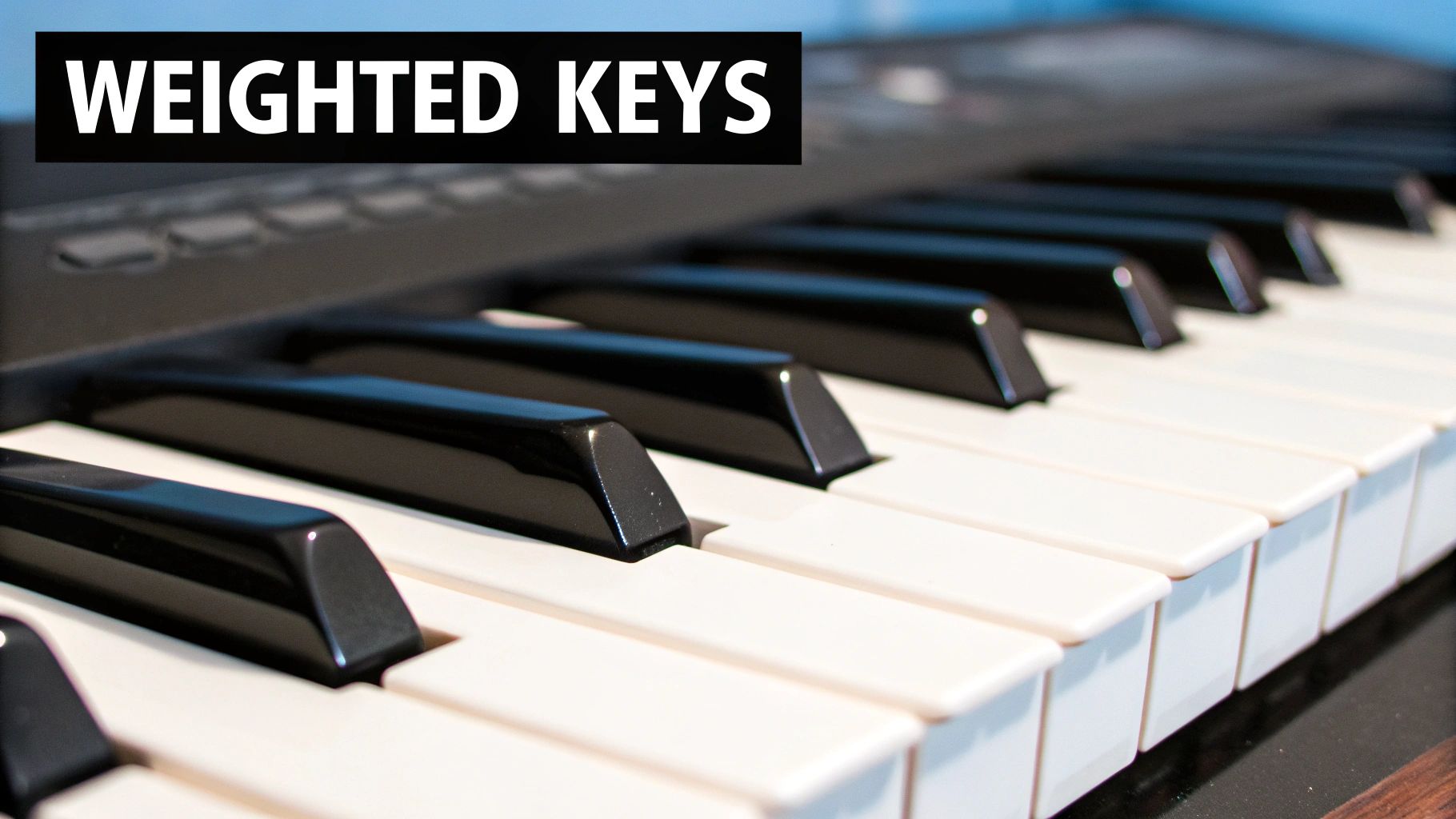
When you press a key on an acoustic piano, you're not just making a sound—you're physically moving a small, felt-covered hammer to strike a string. It’s a beautifully intricate mechanical process, and it creates a specific resistance and response that pianists can feel right in their fingertips. Weighted keys on a digital piano are designed to mimic this exact sensation.
Here’s a simple way to think about it: an unweighted keyboard feels like tapping on a flat, lifeless surface. A piano with weighted keys, on the other hand, is more like pushing a small lever that has a counterweight. It requires more nuance and control, which is the foundation of musical expression. It’s not just about making the keys feel "heavy," but about simulating a genuine hammer action.
This simulated resistance is absolutely crucial for a few key reasons. Most importantly, it builds the finger strength and dexterity you need to play more complex pieces. Without it, a pianist develops a light, underdeveloped touch and will struggle to create dynamic volume changes on an acoustic instrument.
The whole point of weighted keys is to build muscle memory. When your fingers learn the precise amount of force needed to play softly (pianissimo) or loudly (fortissimo), you gain true expressive control over your music.
This focus on an authentic feel is a huge driver in the keyboard market today. The global digital piano market was valued at approximately USD 1.23 billion in 2024, and Australia is playing a key part in this growth, boosting the Asia Pacific market's strong performance.
By starting your musical journey with a digital piano that has properly weighted keys, you're making an investment in your future as a musician. It guarantees a smooth transition to any piano you might play down the road. For instance, playing a quality instrument like the Korg D1 really drives home just how critical this feature is for a genuine playing experience.
As you start looking into digital pianos, you'll quickly realise "weighted keys" isn't a simple, one-size-fits-all feature. The technology that gives a keyboard its unique feel—what we call the key action—can vary wildly from one model to another. Getting a grip on these differences is the key to finding an instrument that really clicks with your playing style and musical ambitions.
The term action is all about the internal bits and pieces—the mechanism that creates resistance and mimics the touch of an acoustic piano. Not all actions are built the same, and they generally fall into three main camps, each offering a totally distinct playing experience.
Think of semi-weighted keys as a happy medium. They're a definite step up from the bouncy, plastic feel of a basic synth-style keyboard, but they don't go all-in on simulating a real piano. They use a smart combo of springs and light weights to give you a bit of pushback. This makes them way more expressive than unweighted keys and strikes a nice balance.
Because they’re lighter and more portable, they’ve become a huge favourite for gigging musicians who need to travel light without sacrificing too much feel. While they’ll help you build some finger strength, they won’t quite prepare you for the heft of a genuine acoustic piano.
This is where digital pianos start to feel seriously authentic. A fully-weighted action uses a mechanism with actual hammers to recreate the resistance you'd feel when your finger causes a felt hammer to strike a string inside a traditional piano. The weight is consistent across all 88 keys, giving you a substantial and satisfying playing experience.
This type of action is fantastic for developing the proper finger technique and muscle memory you need for serious piano playing. It's really the minimum you should look for if you're taking formal lessons or ever plan to play on an acoustic instrument.
At the very top of the food chain, you’ll find the graded hammer action. This is the absolute gold standard for realistic digital piano keys because it doesn’t just add weight—it adds it intelligently. If you've ever played a grand piano, you'll know the hammers hitting the big, thick bass strings are physically larger and heavier than the tiny hammers for the high treble notes.
That means it takes just a little more effort to play a deep bass note than a delicate high one. Graded hammer action perfectly mirrors this subtle but crucial detail.
Graded hammer action is the most authentic simulation you can get. The keys in the low register feel heavier under your fingers, while the keys in the high register feel lighter, creating a nuanced and dynamic feel that's a direct reflection of a concert grand piano.
This chart gives you a great visual of how the resistance changes across a keyboard with a graded hammer action.
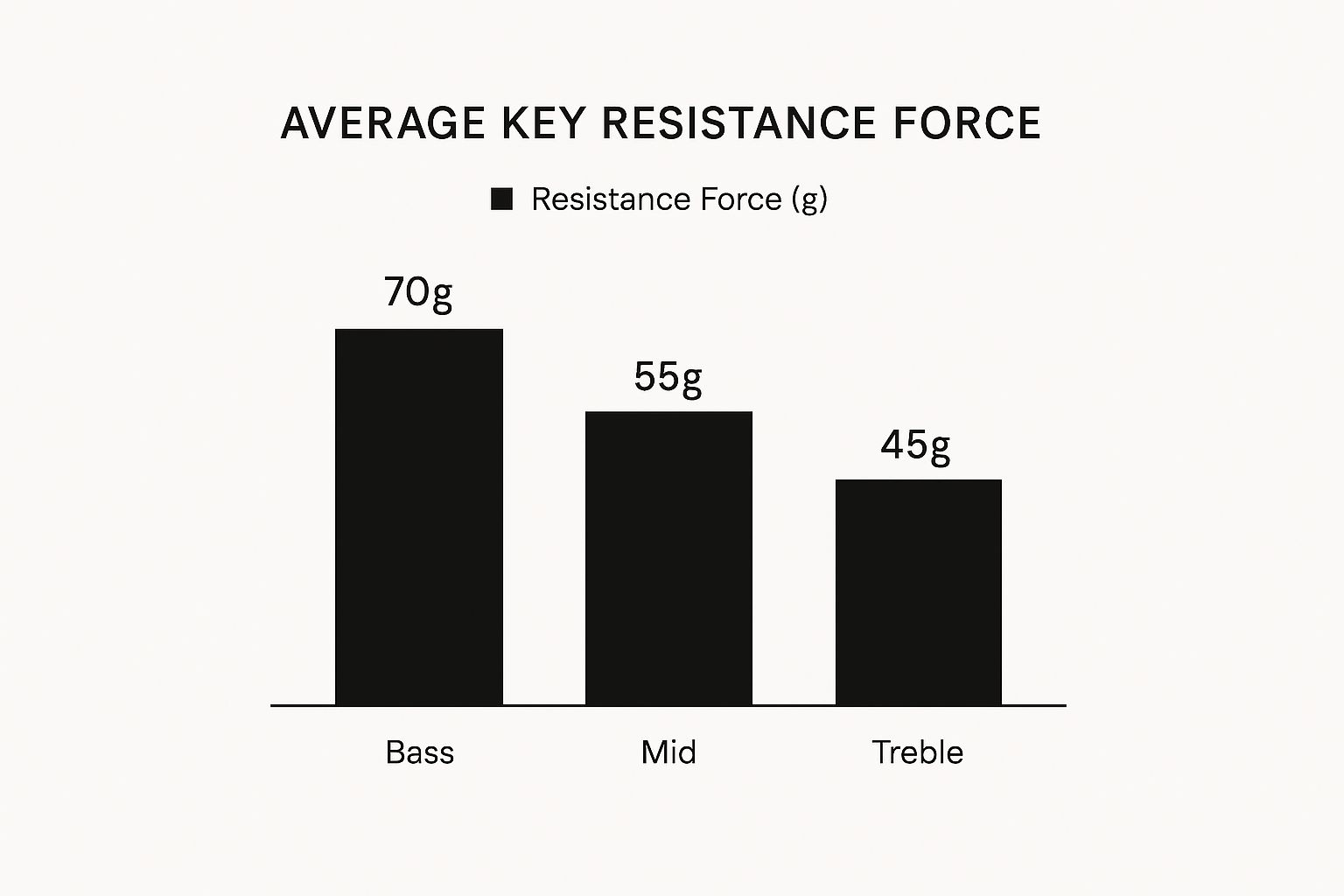
As you can see, the force needed to press a key gradually gets lighter as you move from the bass notes on the left to the treble notes on the right. This is absolutely essential for developing advanced dynamic control in your playing.
Ultimately, picking between these actions boils down to a trade-off between three things: feel, portability, and price. A touring musician might happily sacrifice some realism for a lighter semi-weighted keyboard they can easily carry around. On the other hand, a classical student will find the authentic touch of a graded hammer action non-negotiable for their practice. It all comes down to what you need.
To help you decide, here’s a quick breakdown of how these different actions stack up against each other.
| Action Type | Feel & Mechanism | Best For | Pros | Cons |
|---|---|---|---|---|
| Semi-Weighted | Spring-assisted with light weights. Offers more resistance than a synth but less than a piano. | Gigging musicians, producers, and beginners on a tight budget. | Lighter, more portable, and affordable. Good for playing organ and synth sounds. | Doesn't build proper piano technique or finger strength. Lacks dynamic realism. |
| Fully-Weighted | Hammer-based mechanism provides consistent resistance across all keys, mimicking an acoustic piano. | Serious students, hobbyists, and anyone who wants an authentic piano feel. | Excellent for building finger strength and muscle memory. Realistic and expressive. | Heavier and less portable. Can be more expensive than semi-weighted models. |
| Graded Hammer | Advanced hammer mechanism where keys are heavier in the bass and lighter in the treble. | Classical pianists, advanced students, and anyone seeking the most realistic experience. | The most authentic simulation of a grand piano. Perfect for nuanced dynamic control. | Typically found in more expensive, heavier models. Not ideal for portability. |
Each action type serves a different purpose, so thinking about your own goals is the best way to figure out which one is the right fit for your musical journey.
For anyone serious about learning the piano, digital piano weighted keys are simply non-negotiable. Starting your musical journey with the right feel under your fingertips isn't just a nice-to-have; it's a critical investment in your long-term success, setting the foundation for everything that comes after.
Think of it like learning to drive a car. If you only ever practised in a go-kart with a simple on/off pedal, you'd be completely lost the moment you sat in a real car and needed to feather the clutch or gently apply the brake. The skills just don't transfer.
It's the same story with keyboards. Learning on a non-weighted keyboard teaches your fingers bad habits. You learn to tap, not play. This leads to a flat, lifeless playing style that lacks dynamic expression and is incredibly difficult to unlearn later on.
The gentle resistance of a weighted key does more than just feel good; it's the only way to build proper finger strength, dexterity, and nuanced control. Each key press is a tiny workout, strengthening the intricate muscles in your hands and forearms.
This strength is what allows a pianist to control dynamics—the ability to play a note whisper-soft one moment and powerfully loud the next. Without that crucial resistance, you never develop the muscle memory required for this expressive range.
Imagine a student, Sarah, who spent a year learning on a light, unweighted keyboard. She could play her pieces accurately, but when she sat at her teacher's acoustic grand for the first time, her playing fell apart. The keys felt impossibly heavy, she couldn't control the volume, and her music sounded clumsy and uneven. This is the exact pitfall that weighted keys help you avoid from day one.
Starting with the right tools is essential, and this is especially true in music education. The preference for weighted keys is clear in the Australian market, where music programs emphasise proper technique right from the beginning.
Globally, the beginner digital piano market is forecast to reach $1,056.63 million by 2025, with a huge chunk of this growth driven by learners seeking an authentic playing experience. This tactile feedback is vital for ensuring skills can be transferred to an acoustic instrument down the track.
Ultimately, choosing a digital piano with weighted keys is about setting yourself up for success. It ensures the hours you pour into practising are building real, transferable piano skills.
Now, unweighted keyboards and synths definitely have their place, especially for sound design and production—they just serve a different purpose. For those exploring that side of music, checking out the best synthesisers for beginners can offer a great starting point for electronic music.
For the aspiring pianist, though, the path is clear. Investing in a digital piano with a quality weighted key action is the first and most important step on your musical journey. It's the decision that ensures your hard work pays off, building a solid foundation for a lifetime of playing.
When you start digging into digital pianos, you'll quickly find yourself swimming in a sea of acronyms and fancy brand names like ‘PHA-4’, ‘GH3’, or ‘Grand Feel III’. It’s easy to dismiss it all as marketing speak, but these names actually represent unique design philosophies and technologies that completely change how a piano feels under your fingers. Getting a handle on what the top brands are really building into their digital piano weighted keys is the key to finding the right instrument.
This isn't about picking a single "best" brand. It's more about decoding what each one is trying to achieve. Every major manufacturer—from Yamaha to Roland to Kawai—is chasing the same holy grail: to perfectly capture the complex, nuanced touch of a real concert grand piano. They just take different roads to get there.
Deep down, the differences come from a few crucial engineering choices. One of the biggest is the pivot length—that's the distance from the front of the key to the hinge point way in the back. A longer pivot length, just like you'd find on a grand piano, gives you a much more even and consistent feel, whether you're playing at the very tip of the key or further up. It’s this detail that unlocks greater control and expressive potential.
Another huge factor is what the keys are made of. While plenty of fantastic entry-level actions are built from high-quality plastic, the more premium models start blending in real wood to get closer to that authentic feel.
These aren't just cosmetic choices; the material directly affects how the key behaves when you play it and how it holds up over time.
So, how does all this tech translate to the actual experience of playing? Let’s break down a few features you'll see mentioned all the time.
A triple-sensor system is a big deal in most modern actions. Older digital pianos used two sensors to figure out when a key was pressed and released. Adding a third sensor allows the piano to detect super-fast note repetitions with incredible accuracy. This means you can play rapid passages, trills, and grace notes without the sound "dropping out"—a classic frustration on less advanced models.
At the end of the day, all these technologies are designed to close the gap between digital convenience and acoustic soul. Features like synthetic ivory and ebony keytops aren't just for looks; they provide a slightly porous, textured surface that absorbs a bit of moisture from your fingertips, improving your grip and control during those long practice sessions.
Finally, you’ll run into terms like escapement or ‘let-off’. This is a subtle but seriously important detail for experienced pianists. It simulates the delicate feeling of the hammer "escaping" the mechanism right before it hits the string on an acoustic grand. It feels like a tiny, almost imperceptible notch when you press a key down very slowly. For the discerning player, its inclusion adds a crucial layer of realism that makes the instrument feel alive.
By understanding these engineering details, you can look past the brand names and marketing buzz and start focusing on the specific technology that’s going to feel right for you.
Finding the perfect digital piano isn't about chasing the "best" model on the market. It's about finding the best one for you. The world of weighted keys is all about connecting your personal goals with the right key action, whether you're a serious classical student or a musician on the move.
This is a choice that Australian musicians are taking seriously. In fact, a realistic touch is now a huge factor in what people decide to buy. The Asia Pacific region is a massive player in the digital piano market, with Australia making up about 6.21% of its share. This growth is happening because everyone, from learners to pros, knows how crucial an authentic key action is for building real skill. For more insights on this trend, you can check out the analysis from Cognitive Market Research.
Your musical journey is one of a kind, and your instrument should reflect that. Different types of players will naturally gravitate towards different weighted actions.
The Dedicated Classical Student: If you dream of mastering Chopin or Beethoven, a graded hammer action is essential. There’s just no substitute. You need the most realistic simulation possible to develop the delicate dynamic control and proper technique that classical music demands.
The Gigging Pop/Jazz Musician: When you're playing gigs, portability is everything. A semi-weighted or a lighter fully-weighted action is the sweet spot. It gives you a playable feel that's easy to transport, without the back-breaking weight of a heavy home model.
The Home Studio Producer: If the piano is just one piece of your production puzzle, a solid fully-weighted action is perfect. It feels great for composing parts without needing the absolute nuance of a graded action. This lets you put more of your budget towards other key gear, like the best studio monitors for home recording.
The Casual Hobbyist: Playing just for the love of it? A quality fully-weighted action will give you a satisfying and authentic experience that you’ll enjoy for years, without needing to splash out on the most premium features.
Nothing beats actually sitting down and playing a piano. Your hands will tell you far more than any spec sheet ever could. So, when you go to a store, go in with a plan and pay close attention to the small details that make a big difference.
A piano’s key action is a deeply personal choice. What feels perfectly responsive to one player might feel sluggish to another. Trust your hands and focus on how the instrument responds to your unique touch.
Here's a hands-on checklist to guide you during your test run:
Key Return Speed: Play some fast scales or trills. Do the keys pop back up quickly enough to keep pace with you, or do they feel slow and muddy? A snappy return is vital for playing rapid passages cleanly.
Surface Texture: Run your fingers over the keytops. How do they feel? Many modern pianos feature synthetic ivory or ebony textures that add a bit of grip, which can be a massive help during long practice sessions.
Mechanical Noise: Turn the volume all the way down and just play. Listen closely. Do you hear a lot of distracting clacking, thumping, or clicking? A well-designed action should be mechanically quiet.
Bottoming Out: Press a key down firmly all the way to the keybed. Does it land with a hard, jarring thud, or is there a cushioned, solid feel? A quality action should feel substantial, not like you're just hitting plastic on plastic.
By testing with these points in mind, you can cut through the marketing jargon and make a choice based on what truly feels right for you.
Even after getting your head around the tech, a few questions always seem to pop up right when you’re ready to pull the trigger. Let's clear up these final hurdles so you can choose your ideal digital piano weighted keys feeling totally confident.
Getting these last few details straight can make all the difference in feeling great about your investment.
You can definitely get started on a smaller keyboard, but if you’re thinking long-term, jumping straight to a full 88-key instrument is the smartest move. This is the standard size of an acoustic piano, and learning on one right from the get-go pays off big time.
For one, you won't outgrow your piano as soon as you start tackling more complex pieces that span the full keyboard. More importantly, it helps you build an accurate sense of space and feel for the entire instrument—a core skill for any serious pianist.
This is a fantastic and very common question. Think of "weighted keys" as a broad, catch-all term for any key that has some resistance built in. But "hammer action" is a specific, more sophisticated technology that uses actual little mechanical hammers to create that resistance.
For the most authentic playing experience that builds a proper, transferable technique, you should always prioritise a digital piano with a true hammer action. This is the mechanism that gets you closest to the feel of an acoustic grand, giving you the nuance needed for expressive playing.
Graded hammer action, as we’ve covered, takes this a step further by making the bass keys heavier than the treble keys—the absolute gold standard for realism.
Semi-weighted keys do offer more pushback than the springy keys on a basic synth, so they will help you build some finger strength. They're a massive step up from unweighted keys and are perfect for portable rigs or for playing non-piano sounds like organs and synths.
However, the resistance is still much lighter than a real piano or a fully-weighted action. For any student serious about developing the muscle memory and dynamic control needed for truly expressive playing, a fully-weighted hammer action is essential. It provides the proper resistance to build the precise strength required for more advanced techniques.
Setting a realistic budget is crucial for finding that sweet spot between quality and value. Here in Australia, you can find a solid, entry-level digital piano with fully-weighted keys starting in the $700 to $1,000 AUD range. These instruments provide an excellent foundation for any beginner.
Mid-range models, which often feature more advanced graded hammer actions and better sound engines, typically fall between $1,200 and $2,500. Premium home pianos with top-of-the-line key actions and speaker systems can easily go above $3,000. The best advice? Invest in the most realistic key action your budget can comfortably stretch to.
Ready to feel the difference for yourself? Explore a wide range of digital pianos with exceptional weighted key actions at Sounds Easy and find the perfect instrument to start your musical journey today.
Comments will be approved before showing up.
